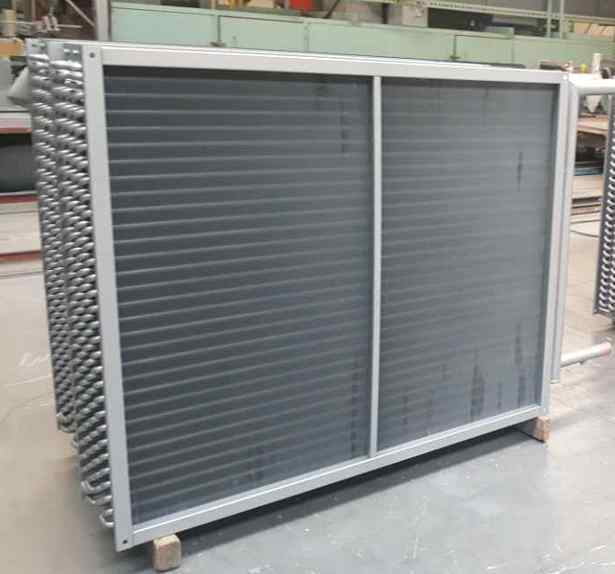
Corrosion affects an HVAC coil’s heat-transfer surfaces, fluid passages and supporting structure. Corrosion of aluminum fins damages the effective heat-transfer area, while corrosion that penetrates copper tubing can lead to refrigerant or heat-transfer-fluid leakage. Galvanized steel (GI) side plates and frames also need protection because they maintain the tube arrangement and the shape of the coil module.
HiGANiC is an organic–inorganic hybrid coating that suppresses corrosion of heat-transfer surfaces and protects the copper tubing and frame. Film thickness and coating application are controlled to preserve airflow passages between the fins. KEMP has directly coated coil interiors and exteriors, side plates and frames at its factory, followed by heat curing and inspection. The purpose is to improve the corrosion resistance of each exposed material and maintain the coil’s function.

Protect the heat-transfer surfaces, fluid passages and support structure
An HVAC coil combines different metals in a complex assembly. Condensate, salt and corrosive gases can affect not only the fin faces but also the copper return bends, tube penetrations through the side plates and inner frame surfaces. Corrosion protection needs to address the materials and exposure conditions at all these locations.

| Component | Function supported by the coating |
|---|---|
| Aluminum fins | Suppress corrosion of heat-transfer surfaces Apply a thin, uniform film while maintaining airflow passages between the fins |
| Copper tubes and return bends | Protect the surfaces of tubes carrying refrigerant or heat-transfer fluid Cover the inner curves of return bends and areas around side-plate penetrations |
| GI frame and side plates | Suppress corrosion of components that support the coil geometry and tube arrangement Protect inner and outer faces, edges and areas around penetrations |
The backs of return bends and the inner faces of side plates are particularly difficult to inspect from the front. Defining coverage for the fins, tubes and frame together brings these areas into the protection specification. Eurovent 6/16 (2021) also recommends full coating of copper tubes and headers, aluminum fins and galvanized frames for cooling coils and evaporators in swimming-pool air-handling equipment.
Zinc and aluminum flakes form a barrier with the hybrid binder
HiGANiC Silver forms its protective film from zinc and aluminum flakes combined with an organic–inorganic hybrid binder. Overlapping flakes lengthen the path that moisture, salt and other corrosive agents must travel through the film. The binder fills the spaces between the particles and seals the substrate surface. This barrier effect provides corrosion protection in a thin film.
The organic component contributes to adhesion and flexibility, while the inorganic component contributes to surface hardness and durability. HiGANiC is applied to GI casings as well as aluminum fins and copper tubes, with substrate-specific pretreatment, application and curing conditions. HiGANiC product and application information
Corrosion and ammonia resistance verified on actual heat exchangers
An actual heat exchanger coated with HiGANiC showed almost no surface change after at least 6,600 hours of salt spray testing (SST). This result demonstrates protection under prolonged salt spray exposure in an assembled heat exchanger with fins and tubes.
| Evaluation | Test article, conditions and result |
|---|---|
| Salt spray resistance | Actual heat exchanger coated with HiGANiC At least 6,600 hours, with almost no surface change |
| Ammonia resistance | Heat exchanger coated with HiGANiC Silver 168 hours of exposure to vapor generated from a 28% aqueous ammonia solution Galvanized steel, copper and aluminum all remained in good condition |
Resistance to salt exposure and resistance to corrosive gases are separate evaluation criteria. Selecting tests for the installation environment, such as coastal or industrial exposure, helps define the protection required for the coil. Ammonia-test photographs and heat-exchanger corrosion performance
A 20–25 μm film balances coverage with airflow clearance
A coil coating must address heat transfer and airflow as well as corrosion resistance. Paint pooling between fins or bridging between opposing coated surfaces can narrow the air passages. HiGANiC Silver has a specified film thickness of 20–25 μm, or 0.020–0.025 mm. Application is controlled to achieve the required coverage at this thickness while accounting for fin spacing.
If each of two opposing surfaces receives a 20–25 μm film, the reduction in clearance is 0.040–0.050 mm. For example, an initial clear gap of 2.00 mm becomes 1.95–1.96 mm after coating. This is an illustrative geometric calculation; pressure drop and heat-transfer capacity are evaluated under the actual coil’s fin geometry and airflow conditions.
The thin film provides the required coverage while controlling its effect on coil geometry and flow passages. Inspection needs to cover uniformity on the fin faces and within the coil, coverage along the inner curves of return bends, and film continuity along frame edges.
5B adhesion and 4H–5H pencil hardness characterize the coating film
| Property | Reported value and function |
|---|---|
| Adhesion | 5B · ASTM D3359-17 Cross-cut evaluation of coating adhesion to the substrate |
| Pencil hardness | 4H–5H · ASTM D3363-05 Evaluation of the coating surface’s pencil hardness |
| Film thickness | Silver: 20–25 μm A specification for thin-film coverage and dimensional-clearance control |
Adhesion is necessary for the protective film to remain attached to the substrate, while surface hardness indicates resistance to scratching under the specified test. Assessing these properties alongside corrosion tests distinguishes the coating’s barrier performance from its mechanical characteristics.
Factory application and curing at 200°C for 20 minutes establish film quality
HiGANiC’s heat-curing condition is 200°C for 20 minutes. KEMP coats the exterior and interior according to the coil dimensions and tube arrangement, then carries out heat curing, cooling, surface inspection and shipment. Drying conditions account for the coil’s thermal mass and the temperature tolerance of its components. Heating, cooling and inspection times are considered separately.
KEMP has directly provided HiGANiC contract coating for HVAC coils and casings since 2016. Experience with coils used in hospitals, libraries, swimming pools and public facilities informs the application direction and access method for different fin, copper-tube and GI-frame materials and geometries.


Define the required performance, then assess maintenance benefits
The coating specification starts with the corrosive agents in the installation environment, required corrosion resistance, fin spacing and protection scope. Once these performance requirements are defined, compare the initial coating cost with subsequent access, removal, repair and reinstallation costs for the same number of coils and the same maintenance period.
Protecting inner frame surfaces and areas that will be concealed after installation allows maintenance planning to address the burden of later access and rework. The economic benefit is considered alongside the required protection performance.
Match the specification to the coil materials and operating environment
Design and quality teams should mark the fin, tube and frame materials, coating coverage, target film thickness, masking areas and inspection locations on the same drawing. Selecting evaluation criteria for salt, condensation and corrosive-gas exposure, together with operating and cleaning conditions, translates coating properties into quality requirements for the supplied coil.

KEMP provides factory contract coating for assembled coils and supplies coating materials. Send overall and side photographs of your coil, together with the installation environment and required performance. We will define the protection scope for each material and the HiGANiC application specification. Discuss HiGANiC application and contract coating
답글 남기기