Improving the installation of fire protection piping starts before the pipe reaches the jobsite. When pipework is fabricated in a shop and assembled on site, consistent dimensions and surface condition help keep installation work on schedule.
Victaulic, a manufacturer of fire protection piping products, highlights reduced installation time, simpler jobsite inventory and prefabrication among the benefits of its systems and services. These priorities show why pipe and fitting suppliers need to consider fabrication, handling and assembly alongside product price and individual performance. Fire protection joining products · Prefabrication and design support
The same requirements apply to surface treatment for grooved fire protection piping. A good finish immediately after plating is only part of the assessment. If grooving damages the coating, or the joint surfaces need further preparation before assembly, additional work follows. Corrosion resistance therefore needs to be considered together with coating condition after fabrication, coupling fit and consistency in production.
KEMP states that Innozinc is the choice of at least 60% of Korea’s fire protection grooved piping market. This figure is supplied by KEMP; a reference year and calculation methodology have not been provided, and it has not been independently verified through a market study.
KEMP Innozinc is a ceramic zinc plating technology that combines zinc electroplating with an inorganic post-treatment. For grooved fire protection piping, the practical question is how to achieve corrosion protection together with the surface quality needed for fabrication and assembly.

Grooved joints depend on both geometry and surface condition
In a grooved joint, the coupling housing engages the grooves at the pipe ends, while a gasket seals the connection. Pipe, grooved fittings, the gasket, coupling housing, bolts and nuts work together as a joint. The assessment therefore extends beyond straight pipe to elbows that change direction, tees that create branches and reducers that connect different pipe sizes. How a grooved joint works

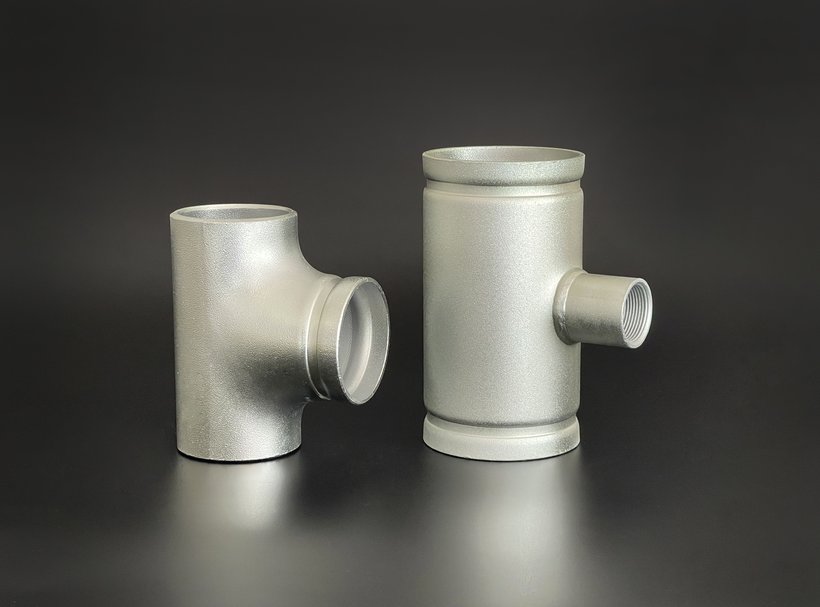

Several functional surfaces meet at the pipe end. The gasket seating area, the groove engaged by the coupling and the degree of pipe-end flare each affect the connection. Victaulic’s technical guidance identifies gasket seating area, groove width, diameter and depth, wall thickness and pipe-end flare as dimensions to control. Groove dimensions and inspection points
The surface treatment needs to accommodate this geometry. Local coating buildup or protrusions may require inspection and dressing before assembly. If fabrication removes or detaches the coating, protection at the affected area needs to be restored. For manufacturers and installers, the frequency of this extra work and how consistently it can be controlled are useful measures of process performance.
How Innozinc combines zinc with an inorganic protective layer
According to KEMP’s technical explanation, Innozinc enhances corrosion resistance during the electrolytic plating stage, then maximizes corrosion protection through a second-stage post-treatment. KEMP describes the plating and post-treatment stages as working together to provide protection.
KEMP’s pipe process documents describe a sequence of substrate preparation, zinc electroplating, activation and stabilization, followed by inorganic post-treatment. The post-treatment is described as interacting with the zinc layer and forming a dense protective structure at the surface.
This makes coating thickness one part of the corrosion assessment. The protective function of the post-treatment, coating continuity and adhesion to the substrate also matter. For grooved pipe, the next step is to examine how these properties affect dimensional control around the groove and surface condition after fabrication.
Internal surfaces require their own process controls. KEMP’s pipe process documents describe auxiliary anodes for internal plating and inclined racking to reduce trapped solution. Pipe diameter and length, the achievable treatment range, and thickness distribution on both internal and external surfaces need to be checked for the actual part.
Choosing the order of grooving and plating for Innozinc
According to KEMP, hot-dip galvanizing cannot be applied after groove formation for this fire protection grooved-pipe application. KEMP states that Innozinc is the only technology that retains excellent corrosion resistance after grooving in this application. The two production routes below refer specifically to Innozinc.
This exclusivity statement is KEMP’s technical claim, not an independently verified conclusion: the range of competing technologies and the post-grooving corrosion test conditions have not been provided. The fabrication photographs below show coating condition on the specimens pictured, while the separate salt spray data describe corrosion behavior of their respective test specimens. These two sets of evidence do not, by themselves, establish exclusivity in corrosion resistance after grooving.
The first Innozinc route is to form the grooves before plating. The pipe is cut and grooved in the factory, then surface-treated. KEMP’s grooved-pipe proposal includes photographs of fittings and pipes produced in this sequence, with close-up views of the external groove area and the inside of the pipe.
This route can be considered when supplying prefabricated pipe for site assembly. The coating must cover the prepared geometry while keeping the finished dimensions within specification. Innozinc’s relatively thin coating is useful when limiting dimensional change from plating. The finished component still needs to be inspected against the specification for the selected coupling.
The second Innozinc route is to groove pipe after plating. Here, the coating needs to accommodate deformation during fabrication. Roll grooving forms a groove by displacing the pipe material, so the groove and adjacent areas need to be checked for cracking and flaking of the coating. Cut grooving removes material and can remove the protective layer; it needs a separate assessment. Roll grooving and cut grooving
KEMP’s pipe and fitting proposal includes a photographic comparison of pipe interiors after on-site grooving. The hot-dip galvanized specimen shows areas where the coating has lifted and peeled along the groove, while the ceramic zinc plated specimen is recorded as having no coating abnormality. This comparison illustrates why coating continuity after fabrication matters and provides evidence for reviewing Innozinc’s performance during grooving.

KEMP’s proposal presents grooving after plating as an application route and discusses formability evidence. Photographs of pipe plated after grooving, and deformation tests on separate specimens, do not establish roll-grooving performance for every pipe specification. Trials using the customer’s pipe material, wall thickness and grooving equipment can establish coating condition around the groove and the quality of the final assembly. Those results provide a practical basis for identifying which finishing or repair operations may be reduced.
What the pipe corrosion comparison showed
KEMP’s fire protection pipe proposal includes a time-based salt spray comparison of hot-dip galvanized, Innozinc and Innozinc-h pipe specimens. The method stated in that document is ASTM B117, with conditions of 35°C and 5% NaCl.
- Hot-dip galvanizing · 70–80 µm
Small amounts of black and white corrosion products were recorded at 24 hours. Localized red rust was recorded at 288 hours, followed by widespread red rust at 576 hours. - Innozinc · 15–20 µm
White rust was recorded at 288 hours. No red rust was recorded through 984 hours; localized red rust appeared at 1,080 hours. - Innozinc-h · 15–20 µm
A small amount of white rust was recorded at 288 hours. No red rust was recorded through 1,080 hours.
Pipe comparison results reported in KEMP’s fire protection pipe proposal. The thicknesses above apply to the specimens in that comparison.
The comparison document does not identify an external testing laboratory or a test report number. These results are presented as the comparison recorded in KEMP’s proposal, rather than as third-party certification.
The relationship between coating thickness and the onset of red rust is the useful finding. In these specimens, Innozinc and Innozinc-h delayed red rust, or prevented its appearance through the final observation time, despite having thinner coatings than the hot-dip galvanized comparison specimens. This gives manufacturers a reason to compare protective-layer design and observed corrosion behavior alongside thickness.
The two Innozinc grades also need to remain distinct. The standard grade showed localized red rust at 1,080 hours; Innozinc-h showed no red rust at that observation time. Both had recorded white rust, so the result should not be described as an absence of all corrosion.

The website image is labeled KS D 9502, whereas the proposal comparison above is labeled ASTM B117. They are presented with their respective source conditions. These accelerated corrosion comparisons of pipe surfaces cannot be converted into years of field service or taken as proof of pressure tightness, leak performance after grooving, or long-term internal corrosion performance in wet fire protection piping.
Carrying quality control through production and assembly
Properties observed on specimens need to be reproduced in production. KEMP’s pipe process documents cover pretreatment solutions, plating current and voltage, plating and post-treatment baths, followed by inspection of appearance, thickness, adhesion and corrosion resistance.
For grooved piping, these controls need to connect to the finished groove dimensions and the condition of the gasket seating area. Pipe plated after grooving requires final dimensional inspection after coating. Pipe grooved after plating also requires examination of the coating around the groove. Recording surface condition before and after fabrication alongside assembly results helps identify where a defect arose and which process conditions need adjustment.
Straight pipe, elbows, tees and reducers differ in shape and solution flow. Identical settings should not be assumed to produce the same thickness distribution on every part. Racking, electrical contact and drainage need to be established for each production item, then checked for repeatability.
KEMP’s website identifies grooved fittings as production plating items and treats pipe processing as a matter for consultation based on length and specification. Reviewing both the fittings experience and the processing range for the proposed pipe helps clarify supply conditions beyond the prototype stage. KEMP pipe and fitting applications (Korean)
Looking at the cost of a completed joint
The economic value of an improved surface treatment appears where additional work can be reduced: dressing surfaces after fabrication, repairing coating damage, sorting and reworking parts with dimensional problems, or replacing components during site assembly.
If trials show that the Innozinc coating remains intact at the fabricated areas and provides the surface condition needed for assembly, some of these operations may be reduced. Supplying pipe grooved before plating and prepared for the intended assembly may also reduce fabrication work at the jobsite.
To evaluate this, compare work time, the number of repair locations and rejection rates for existing products and trial components of the same pipe size and joint type. Adding fabrication, inspection, repair and rework costs to the plating quotation gives a more useful comparison for the customer’s process. Savings reported for finishing welded pipe should not be carried over as a savings rate for grooved pipe; the costs associated with the actual joining method need to be measured.
Planning an application review for your pipework
Surface treatment for grooved fire protection piping brings corrosion resistance, formability and assembly quality into the same review. KEMP Innozinc provides a basis for that review through its combination of zinc and inorganic protection, relatively thin coating, and application documents covering grooved pipe fabrication.
For an application discussion, provide pipe and fitting drawings, material, diameter and wall thickness, the selected coupling and groove specification, the order of fabrication and plating, the corrosion requirement and expected monthly volume. These details help define a coating specification and a prototype evaluation that can show the practical benefits in your manufacturing and assembly process.
Discuss an Innozinc trial for grooved fire protection pipe and fittings · Innozinc technology features
Additional technical and market statements supplied by KEMP on 30 September 2026. Sources: KEMP, Innozinc Pipe Proposal—Grooved, Welded and Threaded Applications (17 March 2025); KEMP, Innozinc Application Proposal for Fire Protection Piping; the KEMP fire protection and piping webpage; and the linked Victaulic technical publications. The KEMP proposal titles are translated from Korean for reference. Product and test photographs: KEMP website. Additional photograph of coating condition after grooving: KEMP, Innozinc Pipe and Fitting Proposal (11 September 2025), slide 7. Online sources checked on 30 September 2026.


답글 남기기